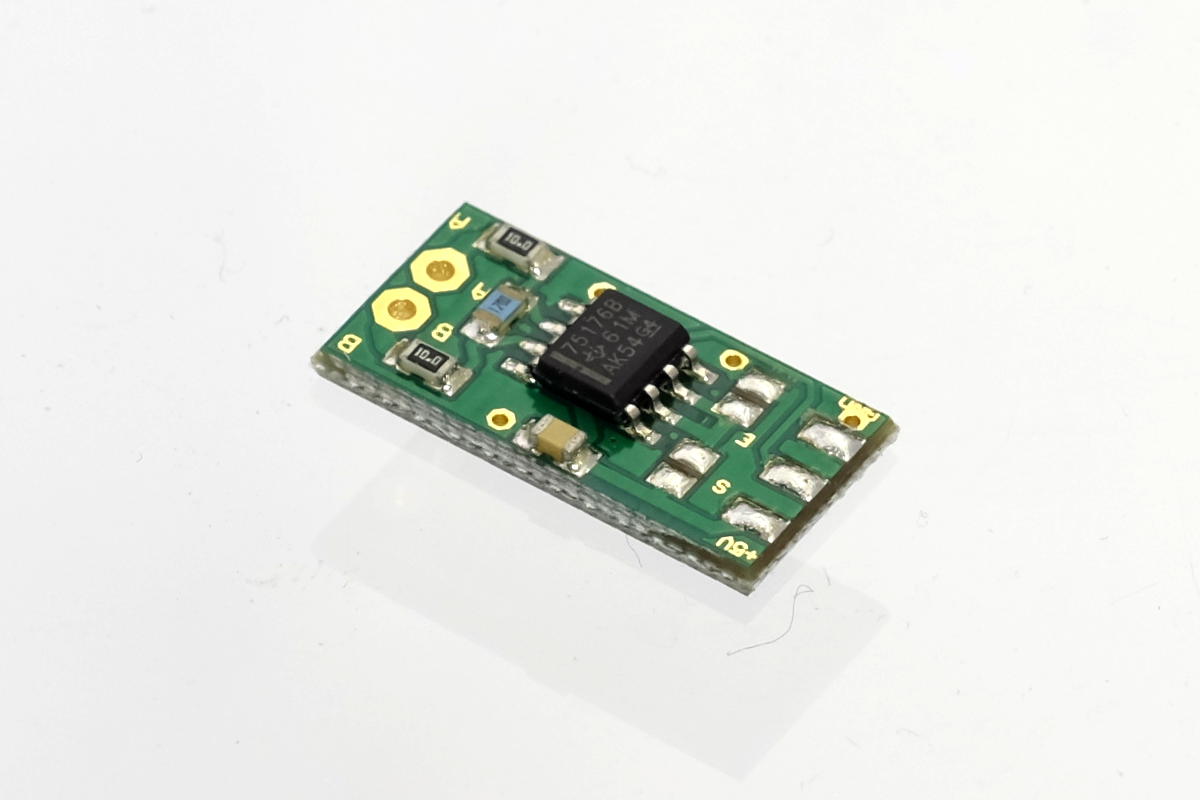
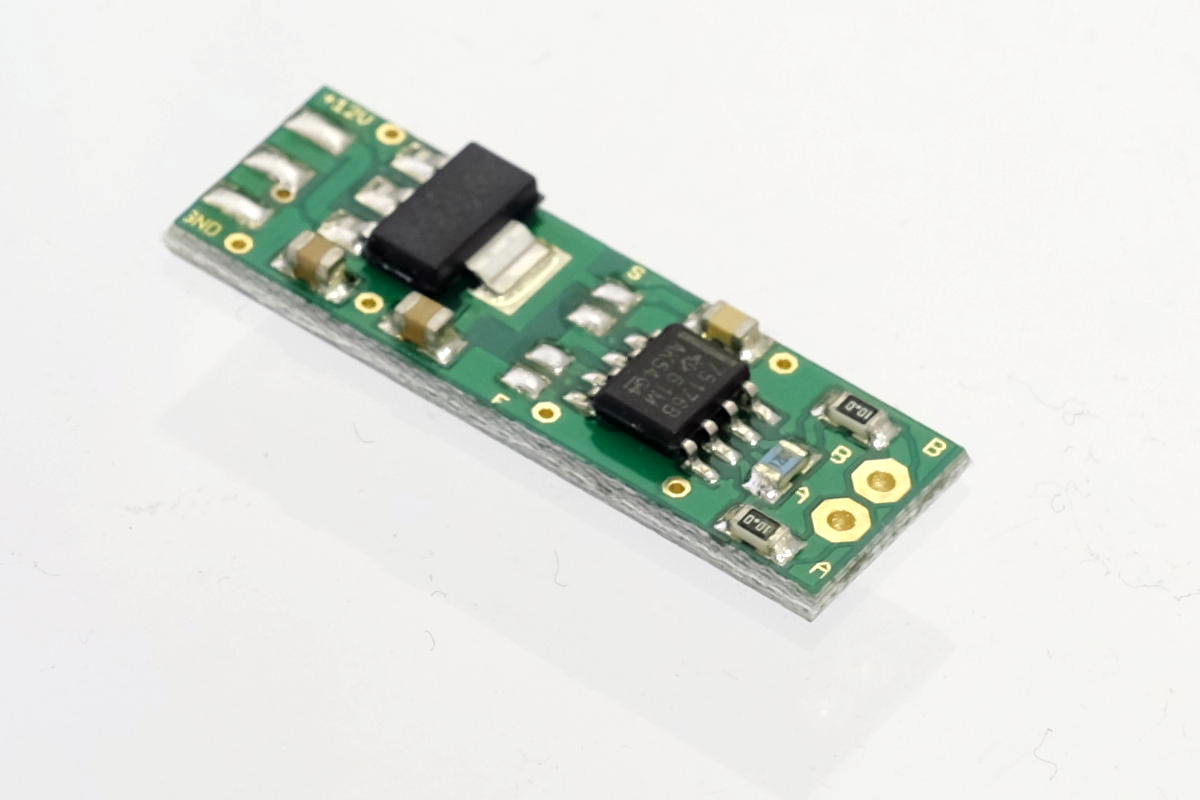
When using digital LED-stripes you can usually realise cable lengths of up to 2m, since the high-frequency signal is quickly distorted and wrong colors are displayed or flickering occurs.
This range-extender allows for cable lengths of up to 50m.
You need a sender PCB at the controller and a receiver PCB at the led-stripe. The mode (sender/receiver) can be set through a solder-jumper.
Attention: Scope of delivery 1 piece. 2 range extenders are always required. One 5V extender on the transmitter side and another 5V, 12V or 24V extender on the receiver side - depending on the voltage of the LED strip.
Technical background:
The signal for digital LED-stripes is relatively low-power but high-frequency. Much data needs to be sent in a short period of time, which is no problem for small installation with short cable-lengths. But with longer cables (over 2m) especially RF-waves, power lines and other electrical devices in the vicinity can cause disturbances relatively quickly.
This range extender eliminates this problem by converting to a symmetrical signal (similar to DMX-signales). Instead of sending the signal on one line, it is transmitted on two lines. One line carries the normal signal, the other is inverted. The relevant information can be read by the difference between the two lines. Since disturbances always influence both lines equally, the information can still be read by the difference between the two lines. At the end of the cable the signal is converted back to the normal format for digital LED-stripes.
You always need two range-extenders, one at the bedinning and one at the end of the data-line.
When using digital LED stripes you can usually realize cable lengths of up to 2m, since the high-frequency signal is quickly distorted and wrong colors are displayed or flickering occurs.
This range extender allows for cable lengths of up to 50m.
You need a sender PCB at the controller and a receiver PCB at the LED stripe. The mode (sender/receiver) can be set through a solder jumper.
Because the 12V range extender produces heat in transmitter mode, it should only be used in receiver mode!
Technical background:
The signal for digital LED stripes is relatively low-power but high-frequency. Much data needs to be sent in a short period of time, which is no problem for small installation with short cable-lengths. But with longer cables (over 2m) especially RF-waves, power lines and other electrical devices in the vicinity can cause disturbances relatively quickly.
This range extender eliminates this problem by converting to a symmetrical signal (similar to DMX-signales). Instead of sending the signal on one line, it is transmitted on two lines. One line carries the normal signal, the other is inverted. The relevant information can be read by the difference between the two lines. Since disturbances always influence both lines equally, the information can still be read by the difference between the two lines. At the end of the cable the signal is converted back to the normal format for digital LED-stripes.
You always need two range-extenders, one at the bedinning and one at the end of the data-line.Note: As an alternative to the 12V RangeExtender, the 24V model with screw terminals can also be used. The 24V model also works with 12V.
When using digital LED stripes you can usually realize cable lengths of up to 2m, since the high-frequency signal is quickly distorted and wrong colors are displayed or flickering occurs.
This range extender allows for cable lengths of up to 50m.
You need a sender PCB at the controller and a receiver PCB at the LED stripe. The mode (sender/receiver) can be set through a solder jumper.
Note: The 24V range extenders also work with 12V and can therefore also be used for 12V systems and LED strips.
Technical background:
The signal for digital LED stripes is relatively low-power but high-frequency. Much data needs to be sent in a short period of time, which is no problem for small installation with short cable-lengths. But with longer cables (over 2m) especially RF-waves, power lines and other electrical devices in the vicinity can cause disturbances relatively quickly.
This range extender eliminates this problem by converting to a symmetrical signal (similar to DMX-signales). Instead of sending the signal on one line, it is transmitted on two lines. One line carries the normal signal, the other is inverted. The relevant information can be read by the difference between the two lines. Since disturbances always influence both lines equally, the information can still be read by the difference between the two lines. At the end of the cable the signal is converted back to the normal format for digital LED-stripes.
You always need two range-extenders, one at the bedinning and one at the end of the data-line.
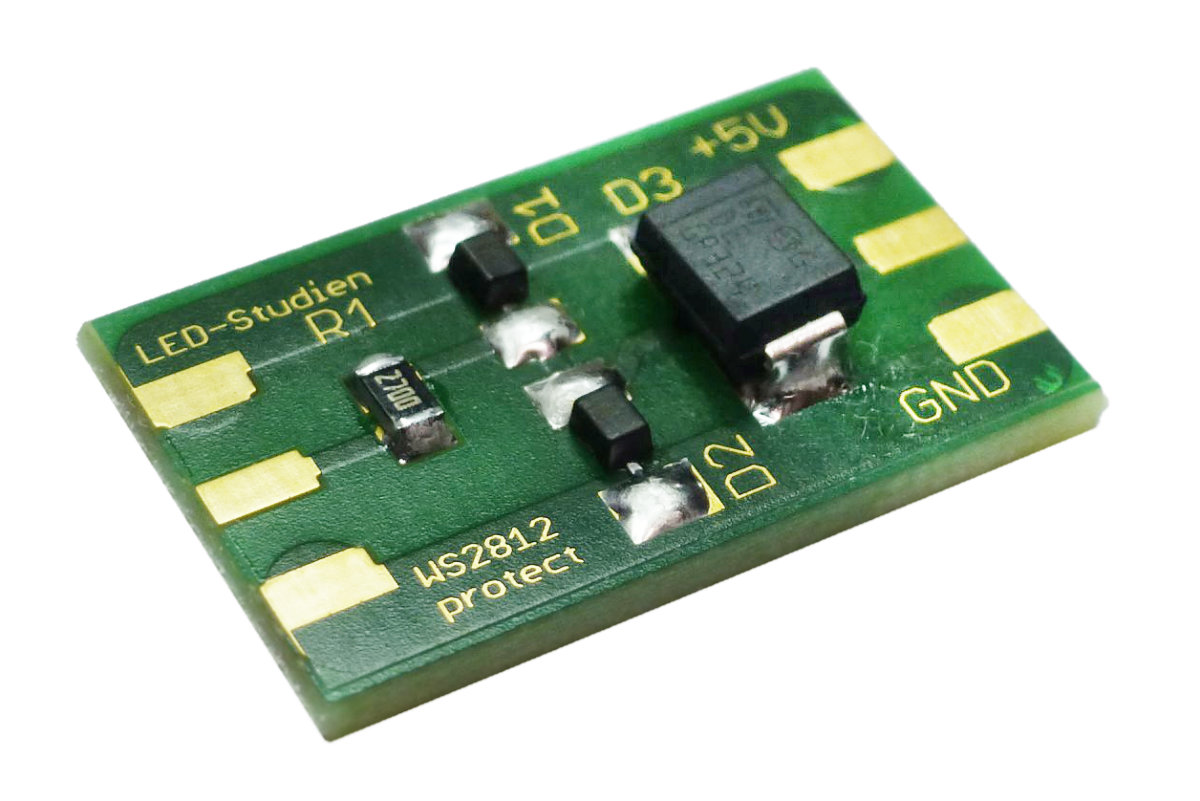
Protection circuit for WS2812-stripe and matrix systemsAt WS2812 the WS2811 is already integrated in LEDs and allows the digital controlling of pixel. Most common is the LED-stripe with WS2812. The available version WS2812B can be very sensitive to voltage peak and ESD. A small cuircuit has been developed to mostly prevent a destruction of the first pixel. A small board is linked directly infront of the first pixel. The board has been designed that a directly connection of a LED-stripe is possible. The connections has to be identical with these of the board.One aspect of the circuit is the serial resistor of 270 Ohm. If you have such a resistor already present on the LED-stripe, you can override it, if it causes difficulties in operation-
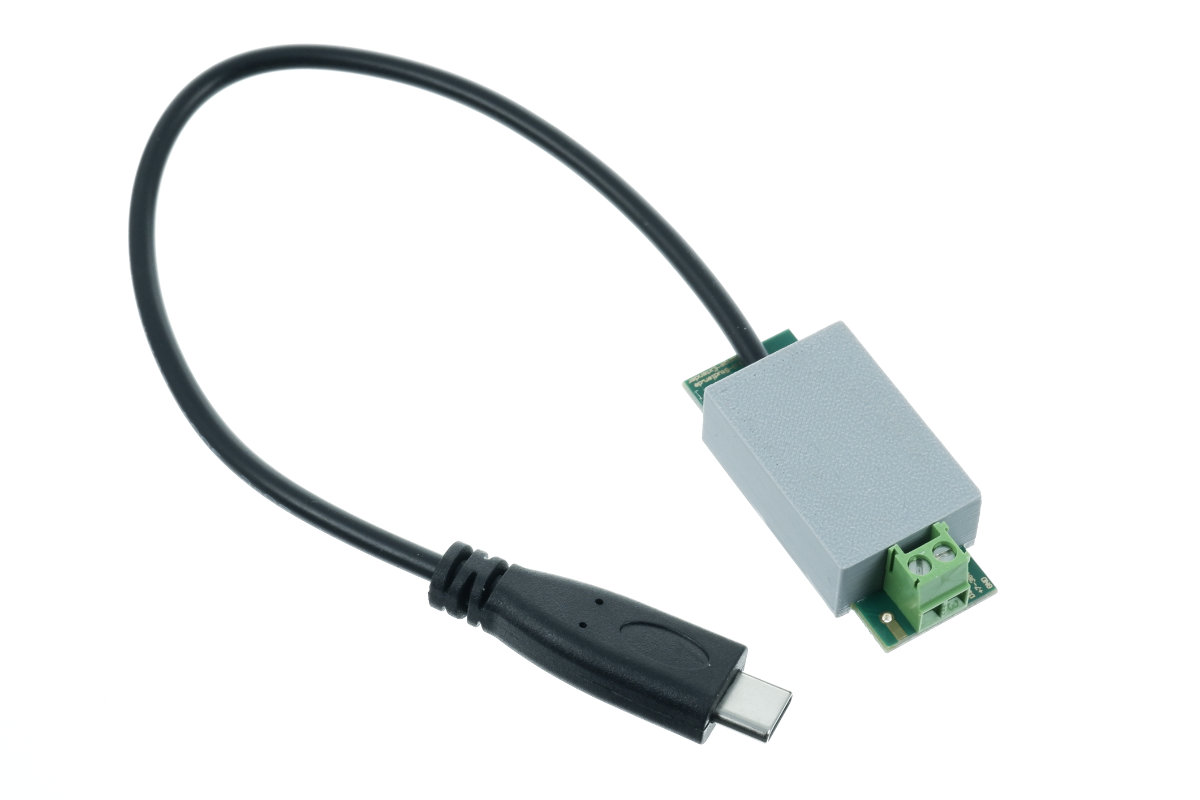
DC-DC voltage converter with 5V output via USB-C connector. Voltage input: 7-30VDC (via screw terminals) Output: 5VDC, max. 0.8A Dimensions (LxWxH): 45 x 20 x 12 mm, plus cable
MADRIX 5 The leading software for controlling LED pixel strips and LED matrix installations MADRIX 5 is one of the most powerful and flexible software solutions for professional LED lighting control. It combines state-of-the-art rendering technology with intuitive workflows, enabling real-time control of complex LED installations—from simple 2D surfaces to volumetric 3D structures. MADRIX 5 is not just a lighting control system, but a specialized real-time media server for LED projects.
ATTENTION: A MADRIX KEY is also required to run the MADRIX software.
1. Core Technology & Performance64-bit rendering engine: This fully optimized engine efficiently utilizes modern PC hardware to render thousands of pixels smoothly at a high frame rate. 2D Pixel Mapping & 3D Voxel Mapping: Complete freedom in placing LEDs within a space. MADRIX treats 3D structures as true volumes (voxels), which goes far beyond conventional 2D projections. Audio-Reactive Visuals: Integrated, high-precision audio analysis (Sound2Light and Music2Light) converts audio signals into spectacular lighting effects in real time. 2. Key Features & FunctionsReal-time effects generator: MADRIX is not just a media player. The software generates effects (scenes, patterns, graphics) in real time, allowing you to adjust their color, speed, and shape at any time. Triggers: Allow effects to be triggered manually via DMX-In or MIDI, turning MADRIX into an interactive performance instrument. Media server functionality: Seamless playback of videos (including audio), images, and live streams. Supports screen capture and scrolling text (ticker). Dual-deck system: Inspired by DJ software, MADRIX features two decks (left/right) with a crossfader to control smooth transitions between different effects and layers. Extensive patching options: With the built-in fixture editor and matrix generator, even complex setups involving different LED types (RGB, RGBW, single-channel, etc.) can be configured quickly. 3. Connectivity & ProtocolsMADRIX 5 serves as a universal interface and supports all common industry standards: Ausgang: Art-Net, Streaming ACN (sACN), DMX512, Philips Color Kinetics (KiNET), DVI, EUROLITE T9, Colour PWM. Inputs/Remote Control: DMX-IN, MIDI, Art-Net Remote, HTTP (web browser control), CITP, SMPTE and MIDI timecode. MADRIX ApplicationsSoftware is always the tool of choice when light is intended not merely to “illuminate,” but to convey meaning or highlight architectural forms: Club & Event Design: Synchronization of light and beat using market-leading audio analysis. Ideal for LED ceilings, DJ booth mappings, and immersive dance floors. Architectural lighting: Thanks to its built-in scheduler (HTTP/Timecode), it is ideal for facade illuminations that need to run automatically and reliably for years. 3D LED sculptures: MADRIX specializes in volumetric mapping. When you suspend LED strings in space (3D matrix), the software calculates effects as actual objects in space (voxels). Exhibition and retail design: Quick implementation of dynamic branding, scrolling text, and video content on LED walls or discreet LED strips without time-consuming pre-programming. Stage shows: As a complement to the GrandMA or other consoles, MADRIX serves as a powerful effects pixel mapper that can be controlled remotely via Art-Net or sACN.
Minimum Technical RequirementsOperating system: Windows 10 / 11 (64-bit)Hardware: Dual-core CPU (2.0 GHz or faster), at least 4 GB of RAM (8–16 GB recommended), dedicated graphics card with OpenGL 2.1 support (NVIDIA recommended).Licensing: Activation is performed via the MADRIX KEY (USB dongle), which allows for flexible switching between different computers.
License Overview – Suitable for Projects of Any SizeThe software is hardware-specific to the MADRIX KEY and is available in various versions, which differ primarily in the number of DMX universes or DVI voxels they output:START - 2 DMX universes (341 RGB pixels): For very small installations and testing.ENTRY - 12 DMX universes (2,048 RGB pixels): For smaller installations, e.g., in bars.BASIC - 32 DMX universes (5,461 RGB pixels): The standard for medium-sized clubs, building facades, etc.PROFESSIONAL - 128 DMX universes (21,845 RGB pixels): For large LED installations.ULTIMATE - 512 DMX universes (87,381 RGB pixels): For very large projects.MAXIMUM - 2,048 DMX universes (349,525 RGB pixels): The largest possible license.